
Choosing an exterior paint color sounds straightforward until you’re standing in front of hundreds of swatches and realizing that the color you loved on your neighbor’s house looks completely different on yours.
Exterior color selection is one of the most common sources of anxiety for homeowners planning a repaint, and it’s easy to understand why.
The stakes feel high, the options are overwhelming, and mistakes are expensive to fix.
The good news is that there’s a real process behind good color selection, and once you understand it, the decision gets a lot less stressful.
This post walks through how professional color consultants approach exterior color choices, and what you can do to make a confident decision before the first coat goes on.
Start With What You Can't Change
The most important rule in exterior color selection is to work with your fixed elements, not against them.
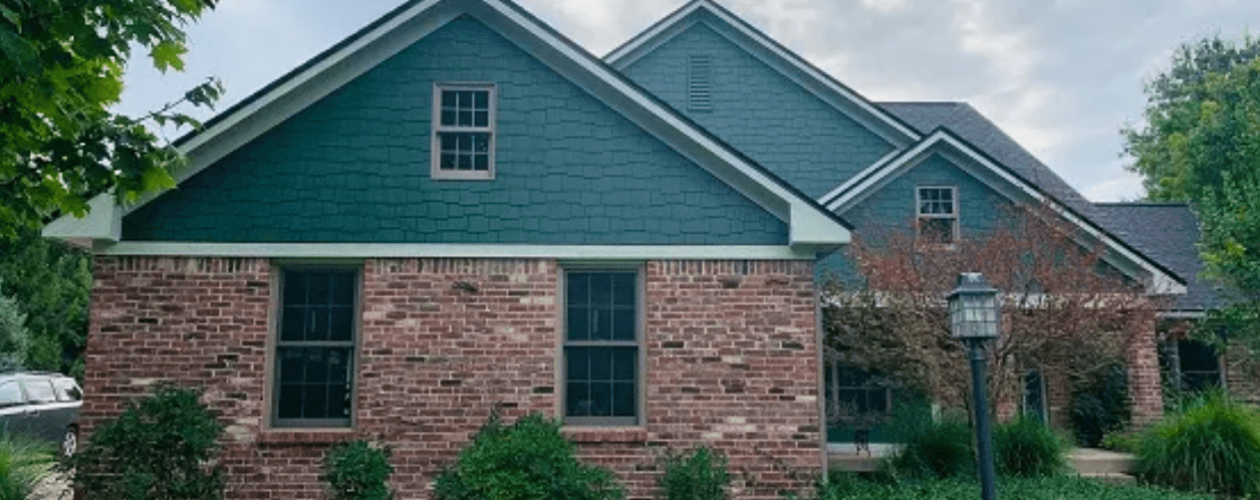
Fixed elements are the parts of your home’s exterior that aren’t changing along with the paint: the roof, any brick or stone accents, the driveway, the foundation, and the surrounding landscape.
Your roof color in particular sets the tone for everything else.
A warm-toned roof with brown or red undertones will clash with cool gray or blue body colors, while a charcoal or black roof pairs well with almost anything.
Before you look at a single swatch, identify the dominant undertone in your roof material and use that as your starting point.
Brick and stone accents are similarly fixed, and they carry strong undertones that need to be acknowledged.
Brick that reads as orange-red is very different from brick that reads as warm brown or pinkish tan, and the body color you choose needs to work with whichever undertone your brick actually has, not the one you wish it had.
Understand How Light Changes Color
Color on a small swatch in a paint store looks nothing like the same color on the full facade of a house in natural light.
This is one of the most common reasons homeowners end up unhappy with a color they thought they loved.
A few things to keep in mind.
North-facing walls receive cooler, indirect light that can make warm colors look muted and cool colors look stark.
South-facing walls get strong direct light that washes out lighter colors and intensifies darker ones.
The time of day matters too. A color that looks perfect at noon can read completely differently in the late afternoon sun or on an overcast day.
The practical takeaway is that you should never make a final color decision based on a small swatch alone.
Get a large sample, paint it on the actual wall in an inconspicuous spot, and look at it at different times of day before committing.
Think in Systems, Not Individual Colors
Exterior color is rarely just one decision.
Most homes have a body color, a trim color, and an accent color for doors, shutters, or other details.
These three elements need to work together as a system, and the relationships between them matter as much as any individual color choice.
A general principle that works well is to let the body color carry the personality of the home, keep the trim lighter or more neutral to provide contrast and definition, and use the accent color sparingly on a front door or shutters to add interest.
This isn’t a rigid formula, but it’s a reliable starting point that avoids the most common mistakes.
Contrast is your friend on trim.
A trim color that’s too close to the body color makes the architectural details of the home disappear.
A trim color with clear contrast, even if it’s subtle, gives the home definition and makes it read as intentional from the street.
Consider Your Neighborhood Without Copying It
Your home exists in a context.
The colors of neighboring homes, the character of the street, and the architectural style of the neighborhood all factor into what will look right on your property.
A color that would be stunning on a farmhouse in a rural setting might feel jarring in a traditional suburban neighborhood, and vice versa.
This doesn’t mean you have to match your neighbors.
It means being aware of the palette that already exists around you and choosing something that fits within it while still giving your home its own identity.
A color that’s slightly bolder than the neighborhood norm can make your home stand out in a good way.
A color that ignores the context entirely tends to look like a mistake, even if the color itself is objectively attractive.
Use Virtual Rendering Before You Commit
One of the most useful tools available for exterior color selection today is digital rendering.
A virtual rendering takes a photo of your actual home and applies the color digitally, so you can see approximately how it will look before any paint is purchased.
It’s not a perfect substitute for seeing paint on the wall in real light, but it eliminates the most obvious mismatches and gives you a much better starting point than guessing from a swatch.
At Heritage Painting, every exterior project includes two free virtual renderings.
Our color consultant will apply your top choices to your home’s actual facade so you can compare them side by side before making a final call.
When to Call in a Professional
Most homeowners can narrow down their choices significantly by following the steps above.
But if you’ve gone through the process and still feel uncertain, or if your home has complex architectural details, multiple materials, or a color history that’s hard to work around, a professional color consultation is worth the investment.
Heritage Painting’s in-house color consultant, Emily King, holds a Bachelor’s Degree in Interior Design from Indiana University-Purdue University Fort Wayne and has over four years of hands-on experience working with paint colors on real projects.
She’s available on every Heritage project at no additional charge, and she can work through exterior and interior color selections with you before your project is scheduled.
Color selection needs to be finalized before a project starts, so the earlier you work through it, the smoother the process goes.
If you’re planning an exterior repaint in Central Indiana, reach out to Heritage Painting to schedule your free estimate and get the color consultation process started.